"Digital business card" now means a dozen different products, and most comparisons stop at the scan. That is the least interesting moment. The scan takes a second. What matters is what you and the other person are left with afterwards, and whether anyone follows up.
Here is how the three kinds of card compare on the things that happen after the handshake.
The exchange
Paper: one-directional. You hand it over; you get nothing back unless they happen to carry cards too. Studies of this vary, but everyone who has emptied a jacket pocket after a conference knows the number is bad.
Standalone digital card: one-directional with a better landing page. They scan, they see your details, they can save a contact. Some products add a "share back" form, but the reply goes to an email or a spreadsheet you have to manage.
Kydero card: two-directional by design. The page has a share-back form, and what they enter becomes a contact or a lead in your CRM, attached to your card as its source. Nobody copies anything.
Carrying it
Paper: a box you forget, then a sleeve you forget to refill.
Standalone digital card: a link, a QR image on your lock screen, sometimes an NFC tag. Fine, until you are at an event fumbling for the right screenshot.
Kydero card: an Apple Wallet or Google Wallet pass. It sits with your boarding passes; on iPhone it is one double-click away. A second, offline pass carries your details inside the QR code itself for halls with no signal.
Keeping it current
Paper: a reprint. Every title change, every new number, every rebrand.
Standalone digital card: the page updates; a pass or screenshot someone saved does not.
Kydero card: edit once. The page, the contact file, and every wallet pass anyone ever added, yours or theirs, update themselves. A rebrand is a card edit plus one "Refresh wallet passes" button.
For a team
Paper: consistency depends on a template someone emailed around in 2023.
Standalone digital card: team plans exist, usually as a separate admin product. Design consistency is a setting; lead routing usually is not.
Kydero card: cards live in the workspace next to the CRM. Each one carries the same logo, colour and wallet design you chose, and each one points at a pipeline, so the sales team's captures go to Sales and the recruiter's go to Candidates, in the same workspace, without a sorting step.
Follow-up
Paper: a pile of cards and good intentions.
Standalone digital card: a list of captures, an export, and a paste into whatever CRM you use. The gap between "scanned" and "in the pipeline" is where most follow-ups die.
Kydero card: there is no gap. The capture is already a CRM record with stages, notes, reminders and appointments. Book a call from the lead and the invite goes out with a Meet link. Win the deal and, if you use Kydero for projects, the project is created from it.
Knowing what worked
Paper: nothing.
Standalone digital card: scan counts, sometimes.
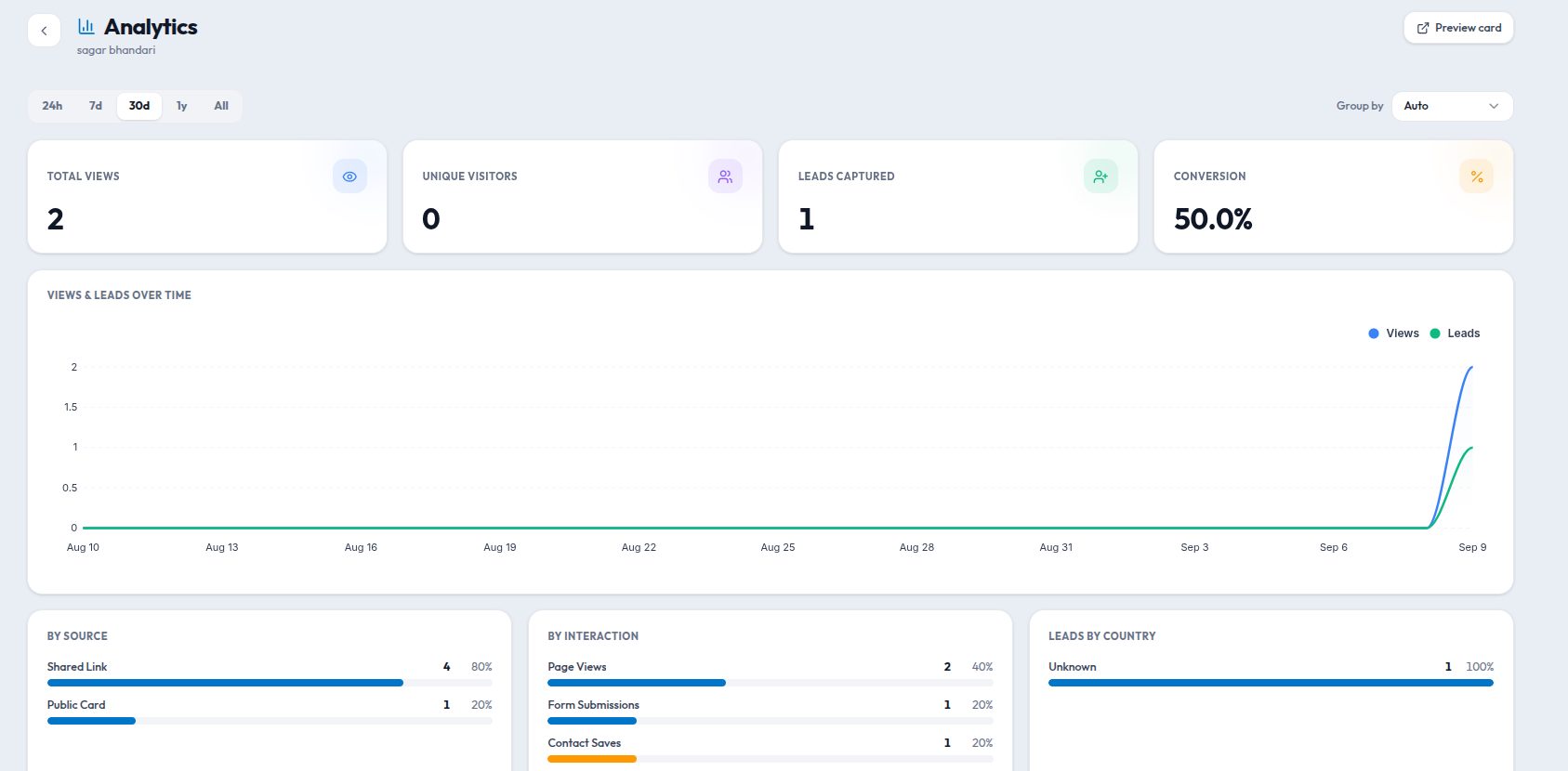
Kydero card: views and captures per card, and because the capture is a CRM lead, you can see which cards produced which deals. That is the number that decides whether a trade show is worth going to again.
When each one is the right choice
- Paper still wins for a formal exchange in cultures where the card itself is a courtesy. Carry a few. Put a QR code on the back.
- A standalone digital card is right if you never follow up systematically and you want a nicer link. There is no shame in that.
- A CRM-connected card is right the moment more than one person is meeting people on behalf of the same company, or the moment you have ever lost a lead between a scan and a spreadsheet.
Kydero's card is the front door to a CRM and project tool, which is why it does the after-the-scan part well: the pipeline is already there. If you only need the door, plenty of products make a good door. If you have noticed that the door is where your leads go missing, that is what the rest of the house is for.